
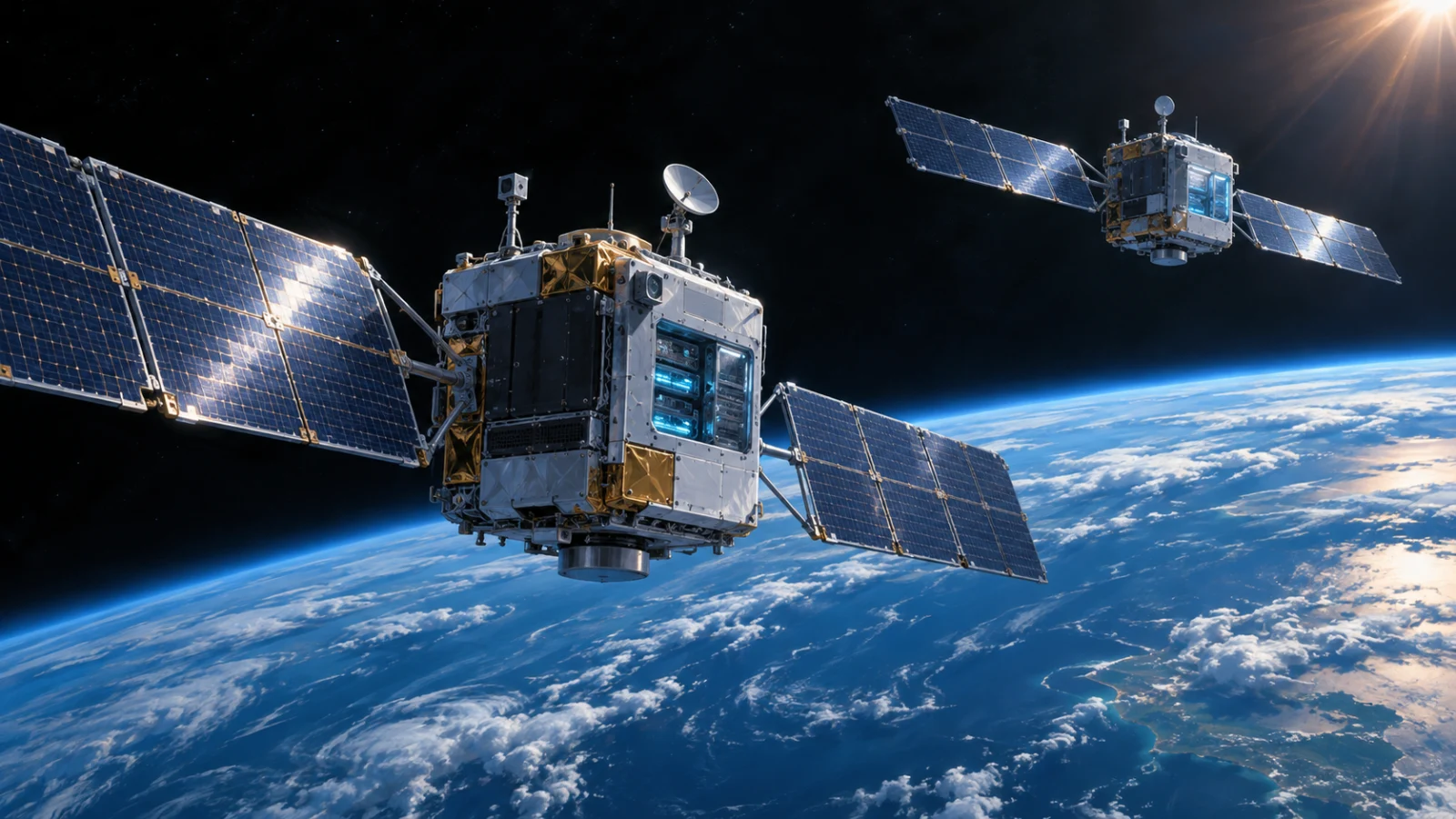
Google’s space-computing experiment now has a larger flight on its calendar. On November 19, the company announced a dedicated New Glenn launch with Blue Origin, targeted for the first quarter of 2029. Satellites described as roughly rack-scale computers will enter sun-synchronous orbit. That is a meaningful commitment to hardware and integration work. The commercial promise still depends on what those machines accomplish after arrival. Google’s launch announcement
The attraction is easy to understand. Electricity, land and construction have become central to the discussion of expanding AI infrastructure. An orbit receiving abundant sunlight offers a striking alternative place to investigate power collection. Our judgment is cautiously favorable toward the experiment, with a demanding condition attached. Suncatcher becomes important when its operators can connect a series of successful demonstrations into a dependable computing service. A launch reservation creates the opportunity to produce that evidence. The evidence will have to cover the entire journey of a workload, including all the unglamorous work that keeps it running.
A sequence of experiments is taking shape#
The recent timeline contains several distinct engineering steps. Google reported an October 1 prototype launch with Planet, followed by an October 30 account of an onboard TPU returning an AI-generated response. The same update identified interconnected satellites in 2027 as the next milestone. The 2029 heavy-lift booking extends that sequence. Keeping the dates separate helps readers follow the questions each experiment can answer, from surviving launch to running hardware, connecting machines and increasing the scale of a deployment. Prototype launch · First response and next milestone
A small onboard response has a precise kind of value. It establishes a working path through hardware, software, power and communications under the conditions encountered during that operation. A research team can then examine telemetry and decide which part of its design deserves the next experiment. Readers should look for the workload duration, the operating conditions and the checks applied to its output. Those details let a demonstration accumulate into knowledge. They also make an unexciting follow-up, such as a repeat run after a temperature change, potentially more informative than a much more theatrical first message.
The heavy-lift reservation adds a different kind of pressure to the program. Hardware intended for a dedicated launch must eventually converge on interfaces, mass allowances, qualification requirements and an integration schedule. A computer design can change quickly on paper. A spacecraft assembled from components with different delivery cycles forces choices to become explicit. That is a worthwhile reason to take the booking seriously. It gives the research an organizing deadline and a route to a larger trial. How much of the design has already converged remains an open question in the short public announcement.
There is also a useful discipline for judging the timetable. Each milestone should retain its own acceptance criteria. An earlier prototype can teach the team something that changes the later flight’s payload or operating plan. That would be a productive research outcome, even if it complicates a simple story of continuous expansion. The strongest roadmap is one that explains how results affect the next decision. A calendar with progressively larger rockets is an incomplete account of progress. The missing information is the set of measurements that gives each new step a reason to proceed.
The electricity advantage has to survive integration#
Google’s original system research explores solar-powered spacecraft carrying TPUs and communicating through optical links. Its proposed configuration connects the orbit, the power system and the computing architecture. That combination matters because an energy advantage becomes useful only after the system can turn it into completed computation. The 2025 research describes a set of design assumptions and investigations that the current flights can progressively test. Suncatcher system research
A rack is a convenient image for the payload’s scale, but the surrounding engineering determines how much useful capacity it delivers. A terrestrial rack participates in a building’s power distribution, cooling, network and maintenance arrangements. Moving the compute hardware to a spacecraft brings those supporting functions into the vehicle’s design and the mission’s operations. This changes the meaning of a capacity comparison. A count of accelerators provides one starting point. The more revealing quantity is the amount of verified work they complete during the time a customer or researcher can actually use them.
Solar collection also creates scheduling choices. A research operator might prefer a workload that can tolerate interruptions or a delivery deadline with some flexibility. A customer expecting a steady interactive service has a different requirement. These are possible demand profiles, and the appropriate one depends on the eventual system’s measured behavior. It would be premature to select the winning market from the launch announcement alone. A compelling test program would explain which workload it chose, why that workload fits its constraints and what performance the same job achieved under a comparable terrestrial setup.
That comparison should include the machine’s whole operating cycle. Setup, data movement, useful execution, checking and recovery all consume time and resources. If an operator advertises a period of uninterrupted solar access, the next question concerns how much of that period was available for useful work at the intended load. This is where a promising physical opportunity meets the habits of infrastructure procurement. Buyers eventually need delivery windows and dependable results. A successful space-computing experiment can make the case stronger by publishing the bridge between energy collected and work delivered.
Cooling deserves a place beside the solar panels#
The thermal problem follows basic spacecraft engineering. Heat can move through structures and internal cooling loops, then leave the vehicle through radiation. The available radiating area, operating temperatures and exposure to the surrounding environment shape the result. NASA’s small-spacecraft engineering survey describes thermal control as a system involving the spacecraft’s materials, geometry, internal dissipation and orbital environment. For a compute payload, these relationships make sustained load a crucial part of any demonstration. NASA thermal-control survey
A useful way to picture the challenge is to start with one completed calculation and follow its energy. Some of the collected electrical power ends up as heat inside components. That heat must reach a surface capable of shedding it at an acceptable temperature. Increasing the electrical supply can therefore require changes elsewhere in the spacecraft. The engineering question becomes how the compute module, the thermal path and the radiating surfaces behave together. A photograph of generous solar arrays leaves this part of the argument open until the team shows the corresponding operating conditions.
Thermal margins also affect the shape of a service. A machine may complete a short burst comfortably and behave differently during an extended job. An operator could choose to lower the load, move work between modules or accept a longer completion time. Each response has consequences for the capacity promised to users. These are general design possibilities, with the actual choices awaiting mission disclosures. The interesting future result would join temperature telemetry to a clear description of the workload, its output and any interventions made during the run. That would let readers understand both the achievement and its operating envelope.
This is a place where patient reporting can improve the public debate. A series of ordinary charts showing temperatures, workload continuity and recovery can carry more meaning than a dramatic rendering of a glowing orbital server farm. Technical transparency gives supporters something concrete to defend and critics something concrete to examine. It also allows the research team to show progress in stages. Resolving one thermal constraint for a specific payload would be a useful result with a defined scope, and it could inform the next design even while broader commercial questions remain open.
Connecting the computers changes the experiment#
A machine executing its own task and several machines sharing a tightly coordinated task place different demands on a network. Google’s system study identifies inter-satellite communications as a major challenge. In a distributed workload, every exchange can become part of the useful execution path. Distance, pointing, synchronization and the behavior of the software around a link all influence the result. The relevant outcome is the performance of the complete workload under its communications conditions. Technical paper
This distinction gives the interconnected-satellite milestone a particular significance. It creates a chance to test how computation behaves when the participating hardware moves through the real orbital environment. A ground demonstration can isolate and improve individual components. A flight can expose interactions that the laboratory arrangement only approximates. The quality of the experiment depends on reporting those conditions carefully. Useful details would include how long the link stayed available, what the workload required from it and what the system did during an interruption. Those observations would help translate an impressive connection into an assessment of usable infrastructure.
The same reasoning applies to the path between orbit and Earth. Data has to reach the place where the work runs, and useful results have to reach the people or systems that need them. The balance varies with the application. A compact request producing a compact answer has a different traffic pattern from a job consuming a changing collection of large inputs. These examples illustrate why a single label such as AI compute covers several operational problems. A credible deployment plan needs to name its intended workload and account for the communications that workload actually requires.
There is a commercial implication as well. Customers purchasing a service usually care about the result at their boundary. They may tolerate internal complexity if its consequences are predictable and priced clearly. A system whose accelerators are fast but whose data path adds uncertain delays creates a different product from one with dependable completion times. The launch provides a platform for investigating that difference. The eventual sales proposition will grow stronger when it includes the whole delivery path in its claims and gives prospective users an honest basis for comparing alternatives.
Reliability includes finding and containing errors#
Radiation introduces another layer of engineering. ESA describes space radiation as a concern for electronic systems, and Suncatcher’s published research includes investigations of accelerator behavior under irradiation. The October prototype updates also identify radiation and thermal conditions among the topics being studied in orbit. These pieces of evidence give the research a clear purpose. The team can compare its assumptions with observations from a functioning spacecraft, then revise hardware and operating procedures accordingly. ESA space-environment overview
The useful question for a computing customer is what happens when an error occurs. Detection, isolation, repetition and verification can all become part of a system’s response. They consume resources, and they influence how much work a nominal amount of hardware can deliver. A resilient design may accept some recoverable events while protecting the validity of the final result. Readers therefore need a description of the checking method alongside any claim about continuous operation. A processor staying powered is one observable achievement. Confidence in its output requires a further account of how that output was validated.
Recovery creates a particularly revealing test. Suppose a workload is interrupted and resumes from a saved state. The important measures include how much work was lost, how long restoration took and whether the completed result passed the same checks as an uninterrupted run. This is a hypothetical example of a useful experiment, offered here as a way to judge future disclosures. It captures the difference between a memorable demonstration and an infrastructure capability that can absorb trouble. The stronger result explains both the disruption and the cost of handling it.
Maintenance belongs in the same discussion. Replacing a module on Earth and replacing capacity in orbit involve different logistics and schedules. A future operator must decide how much redundancy to carry, what failures it can work around and how replacement launches fit its service obligations. Public contract details leave those operating assumptions unspecified. That creates space for productive scrutiny as the program grows. Reliability becomes persuasive when hardware survival, correct output, recovery and replacement are considered in one account, with the remaining uncertainties stated at the same level of detail as the successes.
The cost comparison needs a complete denominator#
Suncatcher’s original research examines how falling launch costs could affect feasibility over time. That exercise is useful as a sensitivity analysis. Its outcome depends on assumptions about costs, lifetime and the amount of useful work a system delivers. A launch agreement is a separate commercial event, and the November announcement leaves its price undisclosed. Readers can therefore treat the booking as evidence of commitment while keeping the economic model conditional. A forecast becomes more valuable when later disclosures show which assumptions have held and which have changed.
A complete comparison would follow equivalent workloads through their respective systems. It would account for launch, spacecraft production, power and thermal hardware, communications, operations, replacement and the resources used by checking and recovery. The terrestrial comparison also needs its full boundary and a stated location and period. The goal is a consistent denominator, such as a verified workload delivered within an agreed window. Comparing a portion of one system’s spending with the entire bill of another can create a striking number that has little relevance to an actual purchasing decision.
Time is part of that denominator. A vehicle waiting for integration or a replacement capacity waiting for a launch slot can have financial consequences even while the computing hardware itself remains intact. Hardware generations can also move forward during the interval between design decisions and deployment. These are questions for the eventual business model, with answers depending on the program’s actual cadence and customers. A useful evaluation would show how sensitive the service is to schedule changes and how its economics respond to a shorter useful life or a different workload mix.
There is room for a rational research investment even while a general-purpose commercial comparison remains unresolved. An experiment can uncover a valuable capability, improve engineering methods or identify a boundary early enough to guide later spending. That gives Google a reason to learn through flights. The public can recognize that value while asking for specific evidence before accepting a broad claim about cheaper infrastructure. The most interesting number after a mission may be the cost of a clearly defined, correctly completed job, accompanied by the assumptions needed to reproduce the comparison.
Orbit is a shared operating environment#
Space infrastructure also has consequences outside its operator’s balance sheet. Satellites occupy a shared environment in which collision avoidance and end-of-life disposal matter. ESA’s debris guidance explains how inactive objects and fragments can create hazards for working spacecraft. Any proposal to scale orbital computing should therefore be assessed alongside its plans for coordination, maneuvering and disposal. The November booking supplies little detail on those subjects, leaving important questions for later mission documentation. ESA debris guidance
The sensible scale of a discussion should follow the disclosed mission. A rack-scale payload, a dedicated launch and an imagined future constellation each create different questions. Readers gain little by combining satellite counts from unrelated proposals or treating a research configuration as a committed fleet. A clearer debate keeps the vehicle, the mission and the prospective architecture identifiable. That discipline also helps with accountability. It makes it possible to ask which organization is responsible for operating each spacecraft, monitoring its condition and carrying out the plan at the end of its life.
Environmental comparisons need a similar boundary. Collecting solar energy in orbit changes where part of the system’s energy comes from. An overall assessment must also consider manufacturing, launch, supporting infrastructure and the service’s lifetime. The appropriate comparison depends on the workload and the terrestrial alternative being displaced. A future published assessment could make these choices explicit and show the sensitivity to different assumptions. Until then, sweeping environmental claims outrun the information in the launch announcement. The project’s research value is compatible with a careful account of its broader resource demands.
Public interest in the idea also raises questions about the shape of the mission. The Reuters account places the agreement within growing attempts to investigate computing in orbit. In one early Reddit thread, a reader asks who will deploy the eventual constellation beyond this single launch. That is a specific reaction from a self-selected discussion, and it identifies a useful question about responsibilities. The program would benefit from answering such concrete questions through mission documentation and results. A measured explanation of a limitation can help readers evaluate the next experiment more effectively than another expansive prediction. Contemporary reporting · Early discussion
Useful progress will be visible in the operating record#
The next persuasive update could take several forms. A longer verified workload would tell us about sustained operation. Repeated jobs under stated conditions would tell us about consistency. A clearly reported connection between satellites would illuminate distributed work. A recovery exercise would show how the design responds to trouble. Each would narrow a particular uncertainty and make the later heavy-lift mission easier to assess. These are the kinds of incremental results that give a frontier project substance, even when they produce a less spectacular headline than the launch contract.
The account should also keep the participants’ roles visible. Google provides the research and computing program, Planet has participated in the prototype effort, and Blue Origin is the announced provider of the dedicated heavy-lift flight. Different partners can contribute to different stages of the roadmap. Readers should be able to trace a claimed result to the specific mission and organization that produced it. That approach makes success easier to credit and a delay easier to understand. It also leaves the technical questions anchored to actual hardware and operations.
Our assessment would become more optimistic with a public record showing correct output, sustained load, dependable communications and bounded recovery costs across repeated runs. It would become more cautious if larger payloads arrived while those operating measurements remained unclear, or if the economics relied on assumptions that flight experience steadily weakened. These conditions keep the judgment connected to evidence that can change. The project deserves curiosity because the experiment is concrete and the engineering questions are consequential. It deserves scrutiny for exactly the same reasons.
A rocket booking gives Suncatcher a date by which many decisions must come together. The interesting frontier begins with what the payload does once the launch is over. Solar collection, heat rejection, data movement, error handling and orbital operations must cooperate long enough to produce useful results at an intelligible cost. If the flights make that chain visible, they will advance the discussion far beyond attractive pictures of computers above the clouds. A dependable operating record is how this particular vision earns the right to grow.