
On November 18, Voyager 1 reached a distance from Earth that light itself takes a full day to cross. The spacecraft, launched in 1977, was about 16.1 billion miles, or 25.9 billion kilometers, away. NASA’s mission team announced the milestone the following day. That timing is more than a ceremonial detail. A signal needs about 24 hours to travel one way, so a question, command and useful response belong to a much slower rhythm than any spacecraft operating near Earth. NASA’s mission announcement
There was also a live engineering wrinkle. Voyager 1 had stopped returning science and engineering data on November 14, although a carrier signal remained detectable. NASA said its team used that carrier and the spacecraft’s known trajectory to confirm the distance milestone. The radio link was present, while the data used to understand the probe and its environment was not arriving normally. Our judgment is that this distinction makes the milestone more informative, not less. It shows what a team can know from different layers of an aging spacecraft’s signal, and what still has to wait for diagnosis. NASA’s November 18 status update
A light-day describes a delay, not just a place#
A light-day is the distance light travels in 24 hours. NASA puts Voyager 1 at about 16.1 billion miles, or 25.9 billion kilometers, from Earth at the milestone. That number is difficult to picture, so the more practical measure is time. A radio signal sent from Earth takes about a day to reach the spacecraft. A reply then needs about another day to return. This is a signal round trip of roughly 48 hours, not a near-instant conversation with an operator.
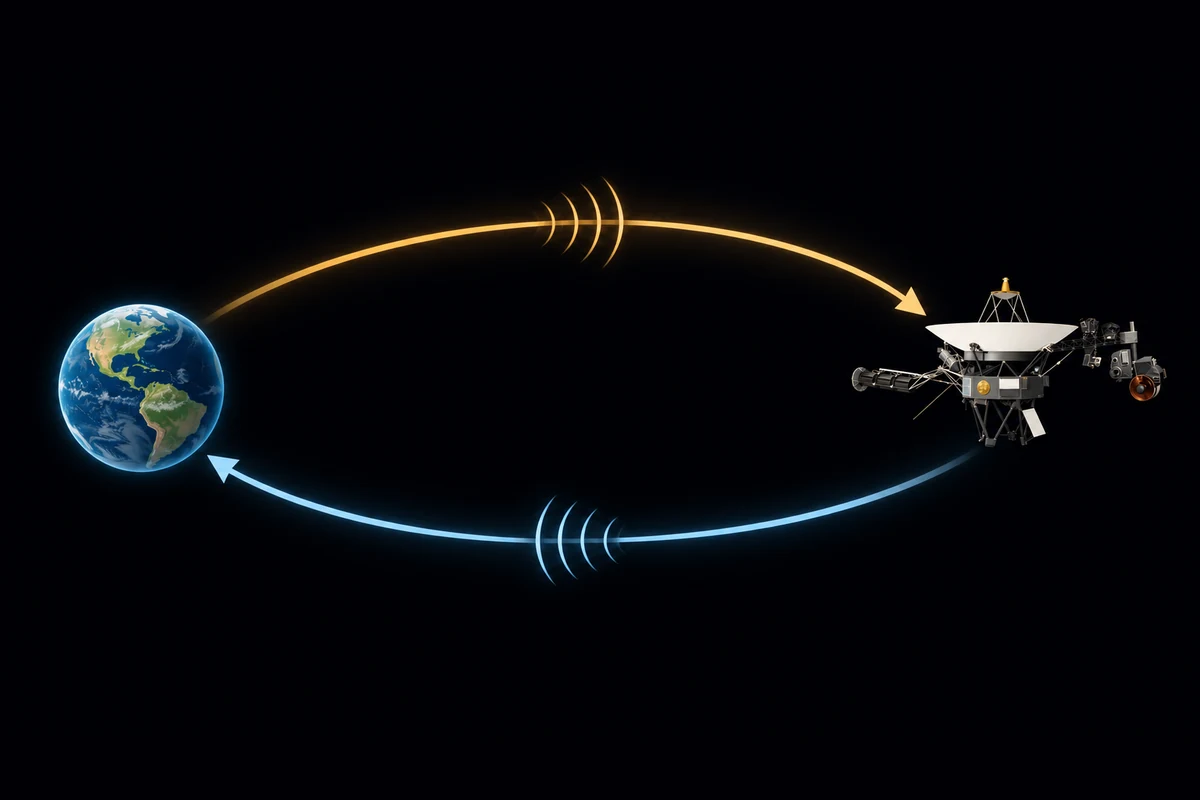
The delay changes the shape of problem-solving. A ground team cannot respond to a brief anomaly while watching it unfold. Engineers send a command or request, wait for the probe to receive it and then wait for a reply. If the returned information is incomplete, the team decides what to ask next with a day-old view of the spacecraft. Many terrestrial assumptions about interactive troubleshooting do not apply. A more useful mental model is a careful exchange of evidence and instructions, with each turn taking long enough that the decision must be prepared in advance.
That communication pace does not mean every operational task takes exactly two days. A radio link can carry different kinds of information, and some signals do not contain the science data engineers need. A detectable carrier can show that the transmitter is active and the spacecraft is pointed toward Earth. It does not by itself explain what the scientific instruments measured or what happened inside a data-processing computer. The information payload and the existence of a signal are separate facts, which the November update made visible.
NASA says the two Voyager probes are the only spacecraft operating outside the heliosphere, the protective bubble of solar particles and magnetic fields. Voyager 1 crossed that boundary in 2012. One light-day is a different milestone. It describes distance and signal travel time from Earth, not the boundary where the Sun’s influence ends. The two achievements are connected by the spacecraft’s long journey but answer different questions. Keeping them distinct prevents a striking distance figure from turning into an inaccurate claim that Voyager has left the solar system’s gravitational reach.
The milestone also sits beside an ordinary operations problem. NASA reported that Voyager 1 had stopped sending science and engineering data on November 14. The carrier signal remained, and the trajectory was known well enough to establish when the craft reached one light-day. That allowed the team to mark the distance while its investigation continued. A precise public account can celebrate progress and state operational limits at the same time. For a probe this distant, that combination is more meaningful than a simple “still talking” headline.
A carrier signal is not the same as telemetry#
A carrier signal is the radio presence that can be detected by ground antennas. NASA says it normally carries science and engineering data from the spacecraft. After November 14, mission controllers could detect the carrier but did not receive the data. That was enough, together with trajectory calculations, to confirm the distance. The distinction tells us that a communication system can remain partly functional while a separate part of the information path is not delivering the records the team expects.
NASA’s November 18 update says the carrier indicated that Voyager 1’s Attitude and Articulation Control computer continued pointing the spacecraft toward Earth, and that the antenna and broadcast equipment still worked. The missing information suggested an issue with the onboard computer responsible for collecting subsystem data, including instrument readings, and formatting it for transmission. NASA described that as an indication under investigation, not a confirmed final diagnosis. The team was still trying to determine the cause and next steps.
This distinction matters to readers because "signal received" can sound like the full flow of science has resumed. NASA’s November 19 release says the team heard from the probe 24 hours after the distance milestone, but also repeats that science and engineering data had not arrived since November 14. The announcement confirms a carrier and the anniversary-distance marker. It does not say the science-data stream recovered. Accurate reporting keeps those statements together rather than letting “phoned home” imply a restored full conversation.
A spacecraft’s telemetry is part of how its operators manage risk. Instrument status, power conditions and subsystem readings help them decide whether to conserve energy, disable equipment or alter operations. Without normal data, the team can still use known trajectory and the carrier, but it has less current information about the craft. The next steps must account for this reduced visibility. That does not mean the spacecraft is out of control. It means that different kinds of control and knowledge depend on different pieces of the system.
NASA linked the current data issue to a broader history of difficult communication. In 2023, Voyager 1 returned a carrier but no data because of an onboard-computer issue, which the team eventually resolved. In October 2026, the spacecraft also experienced an approximately 48-hour communications gap and resumed communication on its own. NASA said it was investigating whether the current data issue was connected to the October gap. These are related operational events, but the agency had not confirmed a common cause at the time of the light-day milestone.
Forty-nine years of operation turns power into a schedule#
Voyager 1 and Voyager 2 launched in 1977 for missions that transformed the study of the outer planets. Their extended operations continue well beyond the original close-up observations of Jupiter and Saturn, with Voyager 2 also studying Uranus and Neptune. Both probes now measure changes in the Sun’s magnetic field at enormous distances. This continuing work depends on power budgets that shrink over time and on carefully selected instruments and systems.
NASA says each spacecraft loses about four watts of power per year as its plutonium-powered radioisotope thermoelectric generator ages. Earlier in 2026, engineers turned off three devices on Voyager 1 and substituted three lower-power alternatives. NASA expected that step to provide enough power for the current suite of science instruments until at least the probes’ fiftieth launch anniversaries the following summer. This is an agency expectation about the current plan, not a guarantee of operation after that point.
Power conservation is a sequence of trade-offs. A watt preserved for one function is unavailable for another. Controllers have to weigh which measurements remain valuable, what hardware needs energy to communicate and how the spacecraft must be oriented. The right decision cannot be made by looking at a list of instruments alone. It relies on mission priorities, observed condition and the remaining energy trajectory. A carrier signal during a data interruption is therefore a narrow but useful piece of evidence, not a complete account of the spacecraft’s health.
The long delay raises the cost of trial and error. If a diagnostic command takes a day to arrive and a response another day to return, a series of experiments can consume substantial calendar time. Engineers need to prioritize requests and interpret each response against a history of previous observations. The 2023 recovery shows why accumulated experience matters. A precedent can help shape the next diagnosis, but it cannot prove a different anomaly has the same cause. That distinction is central to cautious remote operations.
This is where the mission’s human work becomes visible. NASA describes a team that listens to Voyager daily and sends commands weekly. The exact cadence reflects the distance and the operational process, while individual troubleshooting tasks can take longer. Team members decide how to use the bandwidth, power and remaining instruments. For a machine nearly five decades into flight, continued science depends as much on sequencing these choices as on the original hardware design.
One light-day therefore changes more than the answer to “how far away is Voyager?” It sets a practical communication floor for every exchange. Teams need procedures that make delayed decisions explicit. They need to know which telemetry arrived, which remains missing and which conclusions are inferred from the carrier and trajectory. These are standard engineering disciplines made unusually visible by distance. The milestone is a way of understanding the operating environment, not just a number for a poster.
The heliosphere and interstellar space need precise language#
The Voyager probes are often described as having left the solar system, but NASA’s terminology is more precise. Voyager 1 crossed the heliosphere in 2012. The heliosphere is a bubble created by the Sun’s particles and magnetic field that deflects some cosmic radiation. Crossing it means the probe entered interstellar space as defined by the mission. It does not mean it has escaped the Sun’s gravity or traveled beyond every distant component associated with the solar system.
One light-day is a distance from Earth defined by the travel time of light. It is not the heliopause, not the outer limit of the Oort Cloud and not a new boundary of solar influence. It gives a scale for communication. The NASA release notes that light and radio waves travel roughly 186,000 miles (299,000 kilometers) per second in vacuum. A signal from Earth to Voyager 1 takes about 24 hours at the current distance. That relationship is the milestone’s direct operational significance.
Precise distinctions also make the achievement more interesting. The spacecraft crossed the heliopause years ago and continues sampling the environment beyond it. The light-day mark arrives nearly fifty years after launch and measures how far a signal must travel. A distant probe can be in interstellar space while still operating within the Sun’s broader gravitational influence. Different boundaries describe different physical questions. Readers gain more from understanding which question the milestone answers than from compressing every kind of distance into “the edge of space.”
NASA’s public materials include the Golden Record carried by both Voyagers, a phonograph intended as a message to any advanced civilization that might encounter it. That object adds cultural meaning to the mission, but it is separate from the engineering basis of the one-light-day milestone. The record does not transmit the signal or establish the probe’s position. It is part of the spacecraft’s history and purpose, while the current distance is confirmed from trajectory and radio measurements.
This is a broader lesson in communicating exploration. Grand metaphors can make an event memorable, but technical terms tell the audience what actually changed. Voyager 1 is not suddenly in a new region because a radio signal takes a day to reach it. It is farther from Earth than any human-made object has traveled, while the spacecraft continues a mission already operating outside the heliosphere. Those two facts are extraordinary on their own and need no inflated boundary claim.
The mission’s next evidence matters more than its ceremony#
NASA’s team marked the milestone after receiving the carrier signal 24 hours after it was reached. At the same time, the agency said science and engineering data had not been received since November 14 and that engineers were analyzing the issue. The celebration followed an operational confirmation, not a claim that all spacecraft functions had returned to normal. This is a useful example of a public milestone coexisting with unresolved engineering work.
The next important update would identify whether telemetry resumes, what the team learns about the onboard data path and which instruments remain able to operate. If recovery takes time, the method of diagnosis will matter. Was the issue localized to data collection or formatting? Did the October gap contribute? Can the team confirm the fix with known instrument outputs? These are questions, not established findings. They help readers follow the mission without guessing at an answer before NASA has one.
A strong report will preserve the difference between carrier, engineering telemetry and science data. The carrier indicates radio transmission equipment is active. Engineering data describes spacecraft systems. Science data records observations of the surrounding environment. A probe may return one layer while another remains unavailable. That layered understanding applies to many remote systems, from spacecraft to satellites and undersea observatories. The Voyager case makes it unusually easy to see because the one-way light time is so large.
The receiving network is a system of its own. NASA’s Deep Space Network has large radio antenna complexes near Goldstone, Madrid and Canberra. Their positions around Earth allow one site to take over as the planet turns and another loses sight of a distant spacecraft. Voyager’s path is therefore not a single dish pointed continuously from California. It depends on scheduled ground infrastructure, signal processing and teams able to hand observations between sites. The spacecraft is distant, but the communication system is distributed on Earth. NASA Deep Space Network
This infrastructure helps explain why the carrier signal is useful even when data is missing. NASA says it indicates that Voyager 1’s antenna and broadcast equipment are working and that the attitude-control system is keeping the craft pointed toward Earth. That narrows the question. The probe can transmit a radio carrier, while its onboard flight-data subsystem may fail to package measurements for downlink. This is an inference from NASA’s description of the signal and suspected data path, not a final diagnosis. The team still has to isolate the fault.
A practical recovery has to preserve the difference between health information and science observations. Engineers may first need enough status data to know the spacecraft is stable, then restore the path that formats instrument readings, then confirm that each instrument’s information is usable. These stages are a general troubleshooting sequence rather than a claim about the current recovery plan. They show why “the signal is back” and “science operations are restored” should remain separate milestones in future updates.
The long delay also affects how ground teams use the network’s limited time. They do not simply keep a live conversation open for every diagnostic question. Communication windows, competing missions and the probe’s power budget shape when commands and readings can be exchanged. NASA describes the Deep Space Network as supporting many missions around the clock. Voyager’s signal must fit into that shared infrastructure, even when its milestone attracts unusually broad public attention.
The public can also track the distance through NASA’s current Voyager position page. That page uses trajectory calculations and updates the spacecraft’s position, while individual communications arrive with the physical delay. A real-time-looking graphic should not be confused with real-time telemetry. It can calculate where the spacecraft is expected to be, even when new onboard science readings are not arriving. This is a useful distinction for any status display built from models, scheduled updates and direct measurements.
For engineers, the mission’s long-term operation is a case study in graceful degradation. The team can preserve selected capabilities by turning off other devices, maintain a carrier during data problems and use trajectory knowledge while waiting for diagnosis. These are different layers of resilience. None ensures indefinite operation. Together they extend the period in which the spacecraft can contribute and show how planning decades earlier shapes choices today.
The distance also imposes humility. A command is not an immediate correction. A message from Earth cannot be steered into a quick exchange, and the team must work from delayed evidence. A clear account of what is known, inferred and not yet known is therefore part of sound mission operations. NASA’s reporting around this milestone gives readers a basis to follow that distinction. The best tribute to the engineering team is to understand the work accurately, not turn distance into a claim of flawless communication.
Voyager makes endurance a technical practice#
The anniversary-scale life of Voyager 1 can make its continued operation feel almost inevitable. It is not. The spacecraft consumes a finite power source, carries aging hardware and communicates over a distance where each exchange takes days. Its operation continues because people monitor limited signals, prioritize experiments, preserve resources and devise repairs within the constraints of a system designed generations ago.
That work is not merely maintenance after the science. It determines which science remains possible. When power drops by a few watts each year, every instrument choice affects the future measurement portfolio. When telemetry pauses, the team must balance urgency with the risk of sending a command on incomplete information. When a carrier signal remains, it narrows the uncertainty but does not erase it. These decisions create the operational conditions under which a spacecraft can keep returning knowledge.
The current event combines a clean distance milestone with a messy status issue. The spacecraft reached a one-light-day distance on November 18 based on its trajectory. A carrier was available to confirm the event, and NASA’s team received that signal a day later. At that moment, science and engineering data were still interrupted. A reader can celebrate the first human-made object to reach this communication distance and still recognize that the mission was troubleshooting another subsystem.
Our view of the milestone would become more favorable as NASA publishes recovery evidence and distinguishes the return of engineering data from the resumption of individual science instruments. It would become more cautious if the carrier were mistaken for full telemetry or if estimated position were presented as direct observation. Those conditions can be checked against mission updates. They make the public account responsible as well as memorable.
One light-day is a poetic distance with an operational definition. It takes light one day to cross the gap, and a question sent to Voyager waits just as long to arrive. A response makes the full exchange roughly two days. That is the engineering reality beneath the celebration. The spacecraft has reached a remarkable point, and its team continues the slower work of keeping a useful conversation going across interstellar space.